
Table of Contents
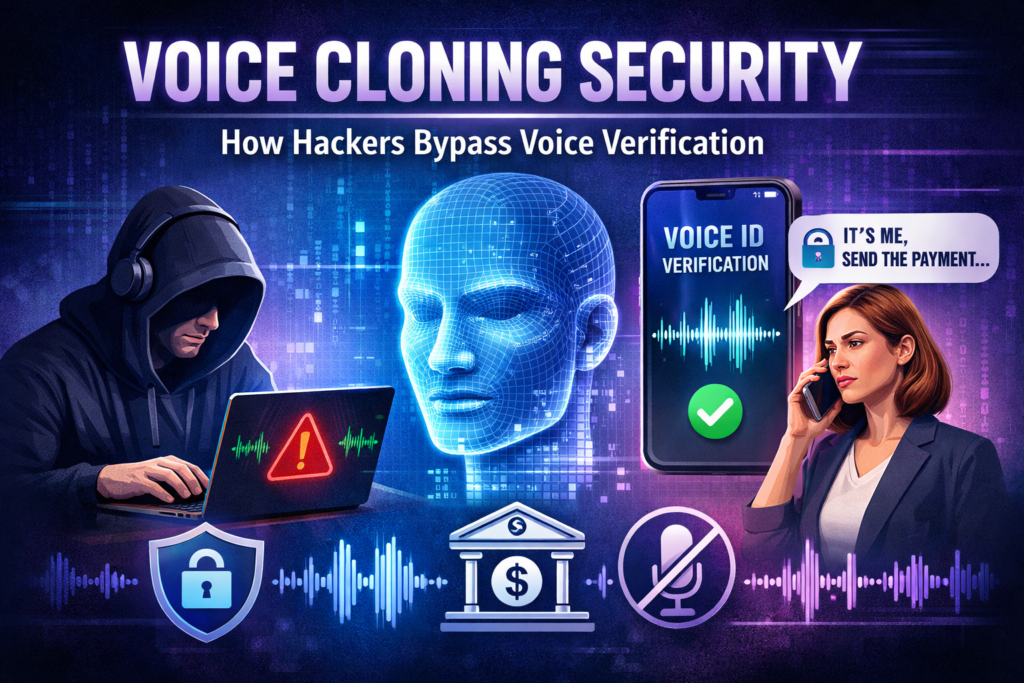
Imagine receiving a phone call from your “boss,” a “client,” or even a “bank representative” — the voice sounds exactly right. Same accent, same tone, same pauses. You trust it. You act on it.But the voice was never real.This is the new reality of voice cloning security, where hackers use AI-generated voice replicas to bypass verification systems and manipulate freelancers and small businesses into giving up sensitive information or money.
Voice-based authentication was once considered secure. In 2026, it’s becoming one of the most exploited weak points in cybersecurity.
What Is Voice Cloning and Why Is It Dangerous?
Voice cloning is an AI technique that analyzes a person’s speech patterns and recreates their voice digitally. With just a few seconds of audio, modern AI tools can produce a highly convincing replica.
Hackers exploit:
- Podcast interviews
- YouTube videos
- Voice notes
- Zoom recordings
- Social media clips
This makes voice cloning security a critical issue, especially for businesses that rely on phone verification, voice approvals, or verbal confirmations.According to the U.S. Federal Trade Commission (FTC), impersonation scams are among the fastest-growing fraud categories, costing Americans billions each year.
👉 FTC Fraud Reports: https://www.ftc.gov/scamshttps://www.ftc.gov/scams
How Hackers Use AI Voice Replicas to Bypass Verification
1. Defeating Voice-Based Authentication
Some banks, customer support systems, and internal workflows still rely on voice recognition for identity verification. AI voice replicas can fool these systems by mimicking:PitchAccentSpeech rhythmEmotional toneThis exposes a major weakness in traditional voice cloning security models.
2. Social Engineering Attacks on Freelancers
Freelancers often work remotely and handle:Client invoicesLogin credentialsConfidential dataHackers use cloned voices to impersonate:Clients requesting urgent paymentsAgency managers asking for account accessBusiness partners requesting password resetsThe urgency and familiarity of the voice override rational suspicion.
3. Internal Business Fraud
Small businesses are frequent targets because they lack layered verification processes. A cloned voice call pretending to be a CEO or finance manager can authorize:Wire transfersVendor changesPayroll modificationsThe FBI has warned that AI-powered impersonation is accelerating business email compromise (BEC) scams.
👉 FBI Internet Crime Report: https://www.ic3.gov
Why Freelancers and Small Businesses Are High-Risk Targets
Large enterprises may have AI-detection tools and multi-layered authentication. Freelancers and small businesses often rely on:
- Trust-based communication
- Verbal approvals
- Speed over verification
This creates the perfect storm for voice cloning security threats.Common risk factors include: Remote work environments
- Publicly available voice content
- Lack of cybersecurity training
- No call-back or verification protocol
Real-World Examples of AI Voice Fraud
In recent cases reported by major cybersecurity firms:
- A finance employee transferred over $20 million after receiving a voice call from a “CEO”
- Freelancers lost entire monthly incomes after fake client calls
- Small businesses approved vendor changes based solely on voice confirmation
Cybersecurity company Kaspersky has warned that AI voice scams are becoming harder to detect than phishing emails.
👉 https://www.kaspersky.comhttps://www.kaspersky.com
Warning Signs of AI Voice Cloning Attacks
Even realistic clones have subtle red flags:
- Unusual urgency (“Do this NOW”)
- Requests that bypass normal procedures
- Refusal to use written confirmation
- Emotional pressure or secrecy
- Slight delays or unnatural pacing
Training yourself and your team to recognize these signs is essential.
How to Improve Voice Cloning Security for Your Business
1. Stop Relying on Voice Alone
Voice should never be the only verification factor.Use:Multi-factor authentication (MFA)Written confirmationsSecure messaging platformsThe Cybersecurity and Infrastructure Security Agency (CISA) strongly recommends layered authentication.
(Outbound reference: https://www.cisa.gov)
2. Create a Call-Back Policy
For any sensitive request:Hang upCall back using a known, saved numberConfirm through a second channelThis simple step defeats most voice cloning attacks.
3. Use Code Words or Verification Phrases
Small teams and freelancers can use:
- Pre-agreed code phrases
- Secure PINs
- One-time verbal passwords
This strengthens voice cloning security without expensive tools.
4. Limit Public Voice Exposure
Hackers need voice samples.
Reduce risk by:
- Avoiding unnecessary public voice uploads
- Limiting long voice notes on social media
- Being cautious with podcast appearances
You can’t eliminate exposure—but you can reduce it.
5. Educate Clients and Teams
Security awareness is powerful.
Make sure everyone knows:
Voice can be faked
Urgency is a red flag
Verification is not “distrust”—it’s protection
Why Voice Cloning Security Will Matter Even More in 2026
AI tools are advancing faster than security policies.
Soon:
- Voice authentication alone will be unsafe
- Deepfake audio scams will increase
- Legal and financial consequences will rise
Freelancers handling client data and small businesses managing payments must adapt early.
Ignoring voice cloning security today can lead to:
- Financial loss
- Client trust damage
- Legal issues
Final Thoughts: Trust, But Always Verify
AI voice cloning is not a future threat—it’s happening now.For freelancers and small businesses in the U.S., the solution isn’t panic. It’s process, awareness, and layered security.If your business still trusts voice alone, it’s time to rethink that strategy.Because in 2026, a familiar voice doesn’t always mean a real person.
Key Takeaway
Voice cloning security is no longer optional.It’s a core part of protecting your income, clients, and reputation.
You may also like this:
Smart Car & EV Cybersecurity: Are Tesla & EV Owners at Risk in 2026?