
Table of Contents
Passwords have been the default security method for decades—but they’re also one of the biggest reasons data breaches happen. In 2025, cybercriminals rely heavily on AI to crack weak passwords, automate credential stuffing, and bypass traditional login systems. That’s exactly why AI-powered passwordless authentication is becoming the new standard for secure digital access.
If you’ve been wondering how passwordless authentication works—or why so many cybersecurity experts recommend it—this guide breaks it down in a human, simple, and practical way.
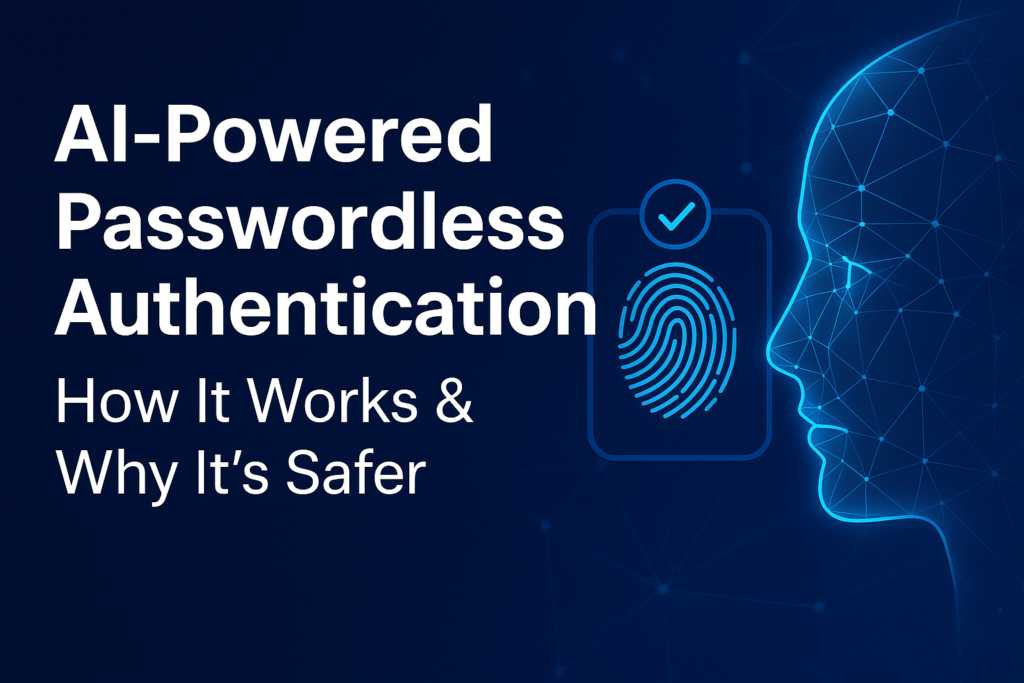
What Is AI-Powered Passwordless Authentication?
AI-powered passwordless authentication is a login method that removes passwords completely and uses biometric factors, device-based verification, or behavioral patterns to verify identity.
Instead of typing a password, users authenticate through methods like:
- Face recognition
- Fingerprint scan
- Email or phone verification
- Hardware security keys
- Device-based passkeys
- Behavioral biometrics
AI takes this to the next level by adding continuous monitoring, anomaly detection, and adaptive security, ensuring the system reacts in real time to suspicious behavior.
For a deeper understanding of passwordless tech fundamentals, you can check out this helpful overview by Microsoft Security:
https://learn.microsoft.com/en-us/security/zero-trust/deploy-passwordless
Why Passwords Are No Longer Safe
The biggest problem with passwords is simple: humans create them, and humans make mistakes.
Here’s why passwords fail:
- People reuse the same passwords across multiple accounts.
- Weak passwords are easy for AI hacking tools to crack.
- Stolen credentials get sold on dark-web marketplaces.
- Phishing attacks trick users into giving passwords away.
According to Verizon’s 2024 Data Breach Investigations Report, nearly 74% of breaches involve weak or compromised passwords.
(Reference: https://www.verizon.com/business/resources/reports/dbir/)
In short: passwords give attackers too many opportunities.
That’s why companies and freelancers across the USA are shifting to AI-powered passwordless authentication for safer protection.
How AI-Powered Passwordless Authentication Works
AI doesn’t just replace passwords—it creates a smarter system that understands patterns, detects anomalies, and adapts instantly.
Let’s break it down.
1. Biometric Verification
AI analyzes unique physical characteristics such as:
- Facial features
- Fingerprints
- Voice patterns
- Iris scans
AI enhances this by detecting deepfakes, spoof attempts, or inconsistencies. Modern AI models compare thousands of live signals in milliseconds to confirm a real human is present.
2. Behavioral Biometrics
This is where AI shines.
Behavioral patterns include:
- Typing speed
- Scroll behavior
- Touch pressure
- Mouse movements
- Navigation style
Even if someone steals your device, AI can detect if the behavior “feels wrong” and block access.
3. Device-Based Authentication (Passkeys)
Passkeys are the future—and the USA has seen huge adoption from Apple, Google, and Microsoft.
AI strengthens passkeys by monitoring device integrity and user behavior.
If anything unusual happens—new device, suspicious IP, abnormal time of login—AI can request additional verification.
4. Risk-Based Adaptive Authentication
AI constantly evaluates risk by analyzing:
- Location
- Device reputation
- Login time
- Previous activity
- Network health
- User history
If risk is low → login is instant.
If risk is high → AI triggers extra verification.
This adaptive security makes it extremely hard for attackers to break in.
Why AI-Powered Passwordless Authentication Is Safer
1. Eliminates Password Weaknesses
No password = no password leaks.
Attackers can’t steal what doesn’t exist.
2. Protects Against AI-Driven Cyberattacks
Hackers now use AI to:
- Crack passwords in seconds
- Create phishing emails
- Guess credential patterns
- Automate brute force attacks
AI-powered authentication fights back by analyzing threat patterns in real time.
3. Stops Phishing Completely
Since there’s no password to harvest, phishing attempts become useless.
Even if users get tricked, attackers can’t access anything.
4. Reduces Human Error
Employees or freelancers no longer have to remember long, complex passwords.
No more:
- Forgotten passwords
- Password resets
- Sticky notes
- “123456” or “Password123”
5. Better User Experience
USA consumers prefer speed and convenience.
Passwordless login takes less than a second, making it perfect for:
- Online banking
- E-commerce
- Remote work platforms
- Healthcare portals
- SaaS tools
6. Stronger Compliance for Businesses
AI-powered authentication supports compliance frameworks like:
- HIPAA
- GDPR
- CISA guidelines
- SOC 2
- NIST
This makes it ideal for cybersecurity-focused businesses, especially those handling personal data.
If you want to explore compliance basics, the NIST Digital Identity Guidelines are a great resource:
https://pages.nist.gov/800-63-3/
Real-World Examples of Passwordless Authentication in 2025
1. Banking Apps
USA banks like Chase and Bank of America use biometrics + AI to secure accounts and detect fraud in real time.
2. Google Accounts
Google has fully rolled out passkeys with AI-powered anomaly detection.
3. Workplaces & Cloud Services
Microsoft Azure, AWS, and Okta use AI to prevent unauthorized logins and insider threats.
4. Healthcare Platforms
With rising medical data theft, AI-powered authentication protects sensitive patient records.
5. Freelancers & Small Businesses
Platforms like Dropbox, Slack, and Notion all support passkey logins, giving freelancers enterprise-level security without IT teams.
The Future of Passwordless Authentication in the USA
By 2026, experts predict that over 60% of digital platforms in the USA will adopt AI-powered passwordless systems as a default login method.
Businesses value it because:
- Data breaches are expensive
- Cyber insurance premiums are rising
- Customers trust secure platforms more
- AI attacks are getting more sophisticated
Passwordless authentication isn’t just a trend—it’s becoming a national cybersecurity necessity.
Conclusion: Why You Should Switch to AI-Powered Passwordless Authentication
The shift to AI-powered passwordless authentication isn’t just about convenience—it’s about survival in a world where hackers use AI to break into accounts 100x faster than before.
Here’s why it matters:
- You eliminate passwords—the #1 cause of breaches.
- AI detects suspicious behavior before damage happens.
- Users get faster, smoother, more secure login experiences.
- Your personal data and business assets stay protected.
Whether you’re a freelancer, business owner, tech enthusiast, or cybersecurity-conscious user, now is the time to embrace a safer authentication method.
Passwordless is the future—AI makes it unstoppable.
Also read : Browser Isolation: The Future of Safe Web Browsing in 2025