
Table of Contents
Freelancers often collect and store more client information than they realize. Contracts, invoices, project files, emails, customer lists, login details, and other business records can remain in cloud storage or on personal devices long after a project ends.
But how long should freelancers actually keep client data?
Quick Answer: Freelancers should keep client data only for as long as it is genuinely needed for the work, a contractual obligation, a legal or tax requirement, or another legitimate business purpose. When the reason for retaining the information ends—and no applicable requirement or exception requires continued storage—the data should be securely deleted, destroyed, or anonymized.
There is no single U.S. data retention period that applies to every freelancer or every type of information. The appropriate period depends on the type of data, your client agreement, your industry, applicable federal or state requirements, and why the information was collected.
A simple data retention policy can help freelancers avoid keeping old client information indefinitely and reduce unnecessary privacy and cybersecurity risks.
What Is a Data Retention Policy?
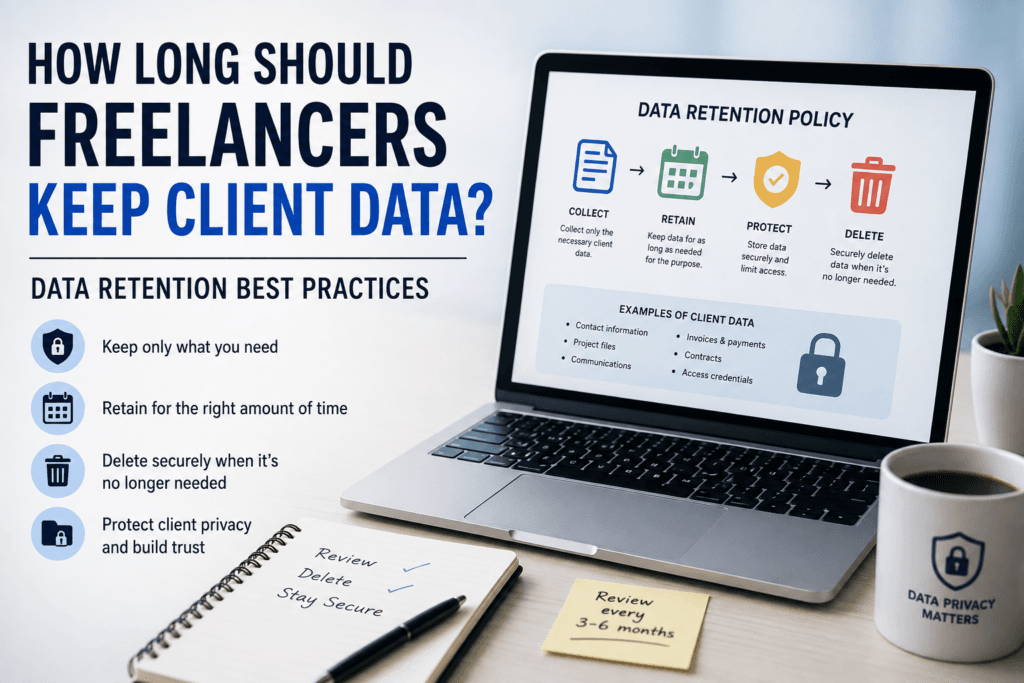
A data retention policy is a set of rules explaining what information you keep, why you keep it, how long you retain it, where it is stored, and when it should be deleted.
For a freelancer, this does not need to be a complicated corporate document. A simple internal retention schedule can cover:
- Client contact information
- Contracts and agreements
- Project files
- Invoices and payment records
- Emails and communications
- Customer information provided by clients
- Website or software credentials
- Analytics information
- Backups and archived files
A useful starting question is:
Do I still have a legitimate reason to keep this information?
If the answer is no, keeping it indefinitely can create unnecessary privacy and security risks.
NIST guidance emphasizes data minimization and disposing of personally identifiable information when it is no longer needed for the relevant purpose.
How Long Should Freelancers Keep Client Data?
There is no universal “30-day,” “one-year,” or “seven-year” rule that applies to every freelancer.
Instead, create different retention periods for different categories of information.
For example, a freelance designer may need to retain final project files according to the client agreement, while invoices and tax records may need to be retained for a different period based on applicable requirements.
Here is a practical starting point:
| Type of client data | Practical retention approach | When to review or delete |
|---|---|---|
| Client contact information | Keep while there is an active relationship or legitimate business need | When no longer needed |
| Project files | Follow the client contract and business requirements | After the agreed retention period |
| Drafts and temporary files | Keep while useful for the project | After completion or the agreed review period |
| Invoices and payment records | Follow applicable accounting and tax requirements | After the required retention period |
| Client emails | Keep communications needed for business, contractual, or legal purposes | Review unnecessary messages periodically |
| Passwords and access credentials | Avoid retaining unnecessarily; use appropriate security tools | Remove when access is no longer required |
| Sensitive personal information | Collect and retain only when necessary | Securely delete when the purpose ends |
| Backups | Establish a defined backup retention schedule | Expire according to the schedule |
These are practical guidelines, not universal legal deadlines. Your industry, contracts, tax obligations, state requirements, and the type of information you handle may require a different retention period.
Why Should Freelancers Avoid Keeping Client Data Forever?
Cloud storage is inexpensive, so it can be tempting to keep every old client folder “just in case.”
But unlimited storage is not the same thing as a good data retention strategy.
The more information you keep, the more information could potentially be exposed if your email account, computer, cloud storage, or another system is compromised.
Keeping unnecessary data can also make it harder to identify important information and increases the number of files that need to be secured.
Effective data retention best practices can help reduce:
- Unnecessary personal information
- Potential breach exposure
- Storage clutter
- Accidental data sharing
- Outdated client records
- Unnecessary access permissions
- Confusion about which files should be deleted
Data minimization is therefore not just a privacy concept. It can also be a practical cybersecurity strategy.Data retention is only one part of protecting client information. For a broader approach, explore our freelancer cybersecurity best practices, including practical steps to protect accounts, devices, and sensitive business data.
What Should a Freelancer Include in a Data Retention Policy?
A simple freelancer data retention policy can answer five basic questions.
1. What Data Do I Collect?
Start by listing the information you actually store.
For example:
- Client names and email addresses
- Contracts
- Invoices
- Project documents
- Customer lists
- Website credentials
- Analytics data
- Support communications
- Payment-related records
You cannot create a useful retention schedule if you do not know what information you have.
2. Why Do I Need the Data?
Document the legitimate business reason for keeping each category.
For example, you may need a contract to document the terms of a project or an invoice for accounting purposes.
If you cannot explain why you still need a particular piece of information, that is a good reason to review whether it should continue to be stored.
3. How Long Will I Keep It?
Assign a reasonable retention or review period based on:
- Business needs
- Client contracts
- Tax or accounting requirements
- Applicable privacy laws
- Industry-specific requirements
- Potential disputes or legal obligations
Avoid automatically choosing “forever.”
4. Where Is the Data Stored?
Make a list of the places where client information may exist.
This could include:
- Google Drive
- Dropbox
- Microsoft 365
- Email accounts
- Your computer
- External hard drives
- Project management platforms
- Accounting software
- Backup services
Remember that deleting the original file does not necessarily remove every copy.
Data may also exist in backups, archives, synced devices, or third-party platforms.
5. How Will I Delete It?
Your policy should explain what happens when information reaches the end of its retention period.
Depending on the type of information and storage system, this could involve secure digital deletion, appropriate destruction of physical records, or removal through a service provider’s retention controls.
NIST guidance recommends secure disposal or destruction of personal information when it is no longer needed.
What Are the Best Data Retention Practices for U.S. Freelancers?
A good data retention strategy does not have to be complicated.
Review Client Data Regularly
Set a reminder every three or six months to review old client information.
Ask:
Do I still need this?
If not, check whether any contractual, legal, tax, or other requirement prevents deletion.
Separate Active and Archived Projects
Keep current projects separate from completed projects.
This makes it easier to identify information that is ready for review or deletion.
Follow Client Contracts
Some contracts specify what happens to project files and client information after a project ends.
Review those requirements before deleting or retaining client data.
Remove Unnecessary Access
When a project ends, review your access to the client’s systems.
Remove access that is no longer necessary and, where appropriate, ask the client to remove your account.
Do Not Store Passwords in Project Folders
Avoid keeping client passwords in Word documents, spreadsheets, emails, or ordinary project folders.
Use appropriate credential-management practices and remove access when it is no longer required.
Document Exceptions
Sometimes you may need to keep information longer than your normal retention period.
For example, a legal dispute, contractual requirement, tax obligation, or other legitimate reason may require continued retention.
Document these exceptions instead of allowing them to become permanent by default.
Review Your Backups
Your retention policy should not focus only on the files you can see.
Consider how long your backup provider, cloud services, email platform, and other systems retain deleted or archived information.
When Should Freelancers Delete Client Data?
Freelancers should generally review information for deletion when the purpose for keeping it has ended.
For example, temporary project files may no longer be necessary after a project and review period is complete.
However, do not automatically delete everything when a project ends.
Before deleting information, consider:
- Does the client contract require retention?
- Is the information needed for tax or accounting purposes?
- Is there an ongoing dispute or legal requirement?
- Is there another legitimate business reason to retain it?
- Does an applicable privacy law affect the deletion request?
If none of these considerations require continued retention, securely deleting unnecessary information can reduce your exposure.
Should Freelancers Keep Client Data Forever?
No.
Keeping client information indefinitely is generally unnecessary and can increase your cybersecurity and privacy risk.
A better approach is to use a defined retention schedule.
For every category of information, decide:
What is it? → Why do I need it? → How long should I keep it? → Where is it stored? → How will I delete it?
This turns data retention from an afterthought into a repeatable security practice.
How Often Should Freelancers Review Their Data Retention Policy?
A practical approach is to review your data retention practices every three to six months.
You should also review your policy when something significant changes, such as:
- Starting a new service
- Working with a new type of client
- Collecting new categories of information
- Changing cloud-storage providers
- Changing accounting or project-management software
- Updating client contracts
- Expanding into another state or market
Regular reviews help ensure that your retention practices continue to match your actual business operations.
What About GDPR and California Privacy Requirements?
Additional privacy requirements may apply if your freelance business handles information covered by specific privacy laws. Your data retention practices should also align with your website’s privacy practices. If you collect personal information from website visitors, learn more about privacy policy requirements for freelancers.
GDPR and Data Retention
If GDPR applies to your activities, its data protection principles include storage limitation. This generally means personal data should not be kept longer than necessary for the purposes for which it is processed.
However, GDPR does not mean that every piece of information must be deleted immediately. Legal obligations and other exceptions can affect how long certain information may be retained.
Freelancers working with clients or individuals in the European Economic Area should determine whether GDPR applies to their particular activities and data practices.
California Privacy Requirements
California privacy requirements may also affect certain businesses that collect or process California consumers’ personal information.
The California Consumer Privacy Act (CCPA), as amended, provides qualifying consumers with various privacy rights, including rights concerning their personal information. Applicable businesses also need to consider data minimization and retention practices.
Whether a particular freelancer is subject to the CCPA depends on the circumstances and applicable requirements.
The important point is that privacy laws do not necessarily mean “delete everything immediately.” Retention requirements, legal exceptions, contracts, and other obligations may need to be considered before information is deleted.
Frequently Asked Questions About Data Retention for Freelancers
How long should a freelancer keep client data?
A freelancer should keep client data only for as long as it is needed for the relevant business purpose, contract, legal or tax requirement, or other legitimate reason. The appropriate retention period depends on the type of information and the circumstances.
What is a good data retention policy for freelancers?
A good data retention policy identifies what information is collected, why it is needed, how long it will be retained, where it is stored, and how it will be securely deleted. It should also account for applicable contracts and legal requirements.
What happens if a freelancer keeps client data too long?
Keeping unnecessary client information can increase the amount of data exposed if an account, device, or cloud service is compromised. It can also create privacy risks, storage clutter, and difficulties managing outdated records.
Should freelancers delete client files after a project ends?
Not necessarily. Freelancers should first check their client agreement, business needs, tax and accounting requirements, and applicable legal obligations. Files that are no longer necessary and are not subject to a retention requirement can then be securely deleted.
Should freelancers keep client passwords?
Freelancers should avoid retaining passwords unnecessarily. Client credentials should be handled using appropriate security practices, and access should be removed when it is no longer needed.
How often should freelancers review stored client data?
Reviewing client data every three to six months is a practical starting point. Freelancers should also review their retention practices whenever their services, contracts, software, or data-collection practices change.
Does deleting a file remove it from backups?
Not always. Deleted information may continue to exist in backups, archives, synced devices, or third-party systems depending on their retention settings. Freelancers should understand how their storage and backup providers handle deleted information
Can a client ask a freelancer to delete their data?
A client may be able to request deletion depending on the contract, applicable privacy law, and circumstances. However, certain records may need to be retained because of legal, accounting, contractual, or other valid requirements.
Final Takeaway
The best answer to “How long should freelancers keep client data?” is not “as long as possible.”
It is:
Keep client data for as long as you have a legitimate reason or applicable requirement to retain it, and securely delete unnecessary information when that reason ends.
For U.S. freelancers and small businesses, a simple data retention policy can make this process much easier.
Start by listing the client information you currently store. Then identify why you need each category, establish a reasonable retention or review period, check your contracts and applicable requirements, and securely delete information that no longer needs to be retained.
Good data retention best practices are ultimately about minimizing unnecessary information while keeping the records your business genuinely needs.
Important: This article provides general cybersecurity and privacy information and is not legal advice. Data retention requirements can vary based on industry, state, contract, business activity, and the type of information involved. When a specific legal or regulatory requirement applies, consider consulting a qualified legal or privacy professional.