
Table of Contents
OAuth attacks are one of the stealthiest cyber threats empowering attackers to hijack business accounts without ever stealing a password. In the U.S., where small businesses and freelancers increasingly rely on cloud tools (Google Workspace, Microsoft 365, Slack, Trello, etc.), OAuth‑related breaches are quietly rising — and many teams don’t even realize what’s happening until it’s too late.
In this article, we’ll break down what OAuth attacks are, why they’re especially dangerous for small businesses and freelancers, and concrete steps you can take now to protect your accounts and data.
What Is OAuth and Why It Matters for U.S. Businesses
OAuth (Open Authorization) is a standard that allows applications to access user data and services without asking for a password. For example:
- Granting a productivity tool access to your Google Drive
- Letting a social scheduler post to your Facebook page
- Connecting your CRM to your emailOAuth makes modern workflows smoother — but it also creates a new attack surface.
In traditional attacks, hackers steal passwords or exploit weak credentials. In OAuth attacks, criminals trick users into granting access to sensitive accounts through legitimate OAuth consent screens. Because no password is stolen, standard defenses like password strength and MFA sometimes fail to stop these breaches.
OAuth Attacks Explained: How They Really Work
Let’s break down how attackers execute OAuth abuse:
1. Phishing for Consent Instead of Credentials
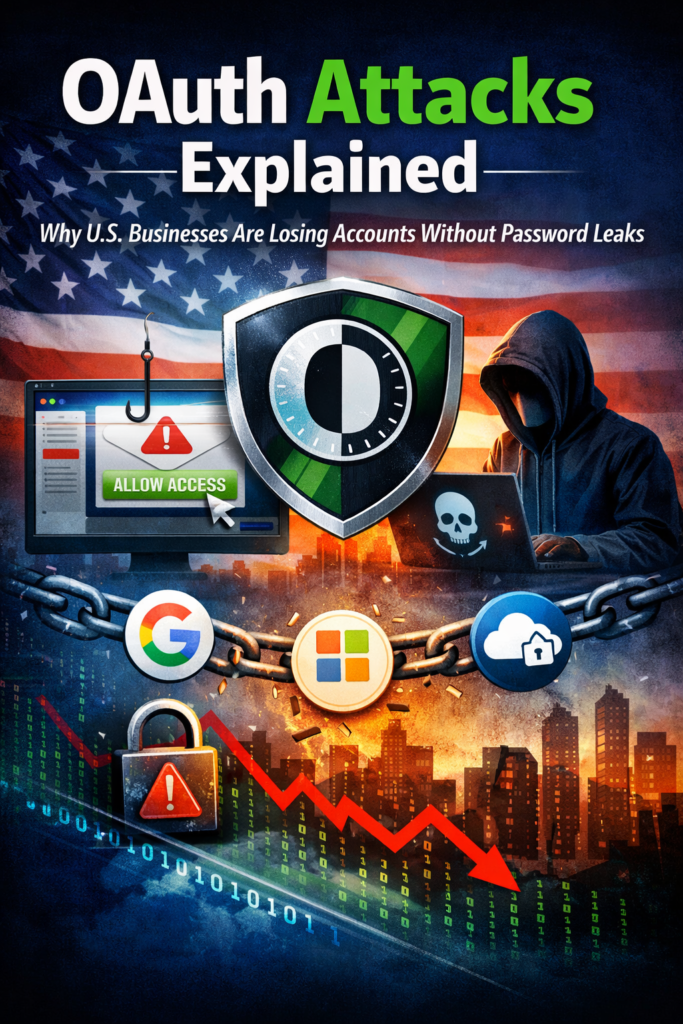
Instead of stealing a password with a fake login page, attackers show you a legitimate OAuth consent screen asking for access to your account. It looks official because it is official — the real OAuth dialog.
Once approved, they get tokens that allow access to your account as if they logged in normally.Here’s an example of what this looks like in action:
👉 Victim clicks “Continue with Google”
👉 OAuth consent screen appears
👉 Victim grants permissions
👉 Attacker gets a non‑password token with account access
Because users aren’t asked for passwords, traditional security systems often don’t flag these consent grants as malicious.
Why U.S. Small Businesses and Freelancers Are Particularly at Risk
Small business owners and freelancers are often more exposed to OAuth attacks for several reasons:
Limited IT Resources
Unlike large enterprises, many small businesses don’t have a dedicated cybersecurity team scanning OAuth app authorizations or tracking risky permissions.
Reliance on SaaS Tools
From bookkeeping apps to CRM systems and project management dashboards, small businesses rely on interconnected cloud
Underestimated Risk Perception
Most people still think of cyber threats as “password theft” or “ransomware.” Few realize they can lose access without a single credential being guessed or leaked.This blind spot makes attackers’ jobs much easier.
Real‑World Examples: OAuth Attacks in the Wild
One high‑profile case involved attackers targeting corporate Gmail accounts through OAuth consent screens. Users received phishing messages delivering request links that appeared to originate from trusted apps.Victims granted wide permissions, and attackers accessed email, contacts, and internal files — all without ever needing passwords.Across industries, OAuth attacks are gaining ground because they:
✅ Bypass MFA in many scenarios
✅ Are harder to detect with standard security tools
✅ Depend on user consent, not password compromise
Even official sources like Google have published OAuth abuse advisories and recommended mitigations for admins dealing with this class of threats. (See Google’s OAuth 2.0 best practices: https://developers.google.com/identity/protocols/oauth2)
Common Types of OAuth Abuse
Not all OAuth attacks look the same. Here are the most common variants:
1. OAuth Phishing
Phishing that delivers a fake app consent screen instead of a fake login page
2. OAuth Token Theft
Attackers steal authorized tokens via malware, session hijacking, or compromised devices.
3. Rogue Apps
Unauthorized applications request overly broad permissions and are granted access by unaware users.
Each of these methods exploits the trust relationship between your cloud account and OAuth‑connected apps.
Signs Your Business May Be Affected by OAuth Abuse
Be alert for these indicators:
🔹 New applications listed in OAuth permissions that you don’t recognize
🔹 Elevated privileges for third‑party apps
🔹 Unexplained data exfiltration alerts
🔹 Suspicious activity that bypasses password or MFA logs
If you see anything like this, your business could be dealing with OAuth abuse — even though no passwords were leaked.
How to Prevent OAuth Attacks (Small Business Focus)
Here are actionable practices tailored for the U.S. small business and freelancer audience:✔️ 1. Limit OAuth App PermissionsOnly grant permissions that are strictly necessary. If an app wants full access to email, file storage, or contacts, evaluate whether it truly needs it.✔️ 2. Conduct Regular OAuth AuditsCheck your Google, Microsoft, and cloud dashboards for connected apps:
Remove any app you don’t recognize.
✔️ 3. Educate Your Team
Train employees to recognize OAuth phishing — for example:
❌ “Click this link and grant access via Google to update your account”
✔️ “Only approve OAuth requests you initiated intentionally”
4. Use Security Tools with OAuth Awareness
Enterprise security platforms may not be affordable for all, but even basic tools that scan OAuth connections can alert you to risky apps.
5. Monitor Logs for Token Grants
Check your cloud admin console logs for suspicious OAuth grant events — especially outside business hours.
Balancing Productivity and Security
OAuth is a powerful tool that enables frictionless workflows. But if your small business or freelance operation treats it like a black box, you’re inviting attackers to exploit the very convenience you rely on.
Think of OAuth this way:
🔹 It reduces friction between apps
🔹 It extends your digital footprint
🔹 But it also increases your attack surfaceThat means increased responsibility, not fear — just smarter access control.
Conclusion: OAuth Attacks Explained — Now What?
OAuth attacks are no longer theoretical — they’re actively used to compromise accounts without password leaks, and U.S. small businesses and freelancers are prime targets due to limited cybersecurity resources and heavy reliance on cloud tools.
To protect your business:
✔ Audit OAuth connections regularly
✔ Educate team members on consent phishing
✔ Limit app permissions
✔ Use OAuth‑aware monitoring
✔ Treat OAuth consent as seriously as a password
Security isn’t about fear — it’s about informed decision‑making and proactive defense.If you want deeper insights on protecting your U.S. business from evolving threats like OAuth attacks and more, check out other cybersecurity resources here:
If you want deeper insights on protecting your U.S. business from evolving threats like OAuth attacks and more, check out other cybersecurity resources here:
🔹 OWASP OAuth Security Guide – https://owasp.org
🔹 Google OAuth Best Practices – https://developers.google.com/identity/protocols/oauth2
You may also like this blog:
Shadow API Risks: The Hidden Cybersecurity Threat Most U.S. Small Businesses Miss