
Table of Contents
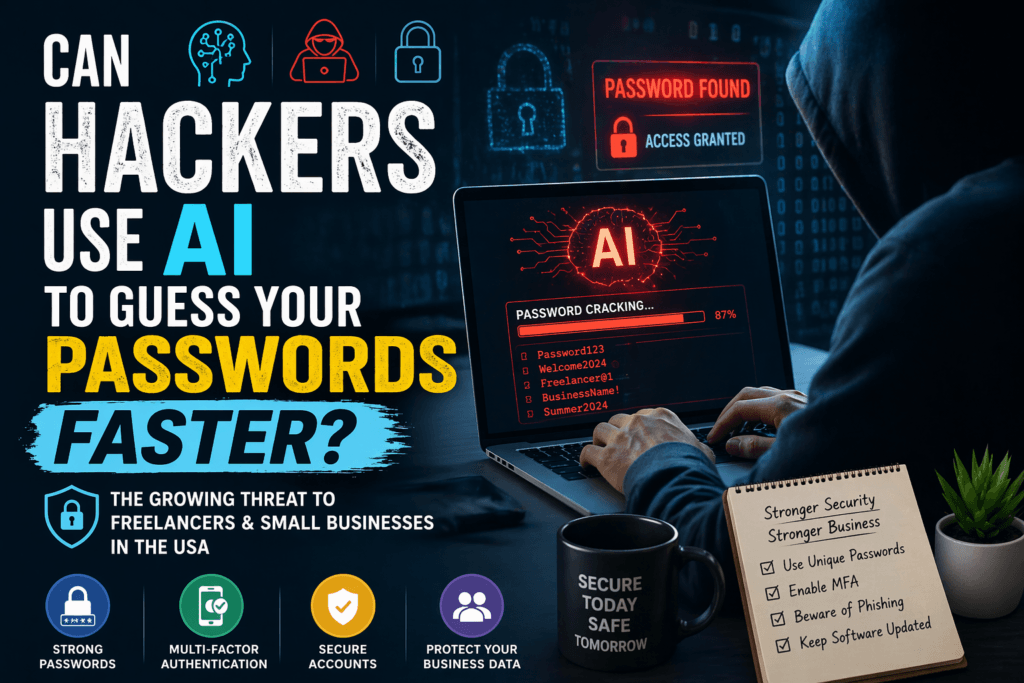
Can hackers use AI to guess passwords for small businesses? Many U.S. freelancers and small business owners are starting to ask that question as cybercriminals adopt more advanced tools. Artificial intelligence is no longer just helping legitimate companies automate tasks—it is also giving hackers new ways to analyze weak credentials and break into accounts faster. For freelancers who manage client files and small businesses that store sensitive customer information, a single compromised password can lead to serious financial and reputational damage. Understanding how AI-driven password attacks work is the first step toward protecting your business from a threat that is becoming more sophisticated every year.
Artificial intelligence has changed the cybersecurity landscape. While many businesses use AI to improve productivity, cybercriminals are also using AI-powered tools to crack weak passwords, automate attacks, and identify vulnerable accounts faster than ever before.
If you work as a freelancer or run a small business in the United States, understanding how AI-driven password attacks work can help you protect your data before attackers exploit it.
How AI Makes Password Cracking Faster
Traditional password attacks relied on brute force methods. Hackers would manually test thousands or millions of password combinations until one worked.
Today, AI can accelerate that process by:
- Learning common password patterns
- Predicting human behavior
- Identifying reused credentials
- Automating login attempts
- Prioritizing likely password combinations first
Instead of trying random combinations, AI systems can analyze leaked password databases and detect patterns such as:
- Birthdates
- Pet names
- Business names
- Keyboard sequences
- Common substitutions like “P@ssw0rd”
Because people often create predictable passwords, AI can significantly reduce the time needed to break into accounts.
Why Freelancers and Small Businesses Are Easy Targets
Freelancers and small businesses often become targets because they may lack enterprise-level cybersecurity.
Common weaknesses include:
Weak Password Habits
Many users still create passwords like:
- CompanyName123
- Summer2026
- Freelancer@1
These are easier for AI tools to predict.
Password Reuse
Using one password across:
- cloud storage
- invoicing software
- banking portals
creates a bigger risk because one stolen password can unlock multiple accounts.
Limited Security Resources
Small businesses usually do not have:
- security teams
- password managers
- regular monitoring tools
That makes them attractive to attackers.
AI Password Guessing Is Not Just Theory
Security researchers have already demonstrated how machine learning models can improve password cracking.
A study published by Home Security Heroes found that AI models could crack many common passwords in less than a minute by analyzing password patterns.
These systems can:
- recognize character habits
- predict likely changes
- simulate human password choices
You can read more about password security guidance from the Cybersecurity and Infrastructure Security Agency. Their recommendations remain important for businesses of every size.
For official password best practices:
https://www.cisa.gov/secure-our-world/passwords
How Hackers Use AI Against Businesses
1. Credential Stuffing
AI can test stolen passwords across multiple websites automatically.
If you reused a password from an old breach, attackers may gain access quickly.
2. Phishing Personalization
AI can generate highly convincing emails that look real.
For example:
- fake invoices
- client messages
- urgent tax notices
These emails trick users into revealing passwords.
3. Smarter Brute Force Attacks
AI can prioritize likely combinations first rather than wasting time on random attempts.
This makes attacks:
- faster
- cheaper
- harder to detect
Signs Your Passwords May Be Vulnerable
You may be at risk if you:
- use fewer than 12 characters
- reuse passwords
- include your business name
- use simple symbols
- rely on memorized passwords only
Example of weak password:
Freelance2026!
Example of stronger password:
BlueRiver!Coffee42&Studio
Longer passwords are much harder for AI systems to crack.
How to Protect Against AI Password Attacks
Use a Password Manager
Password managers create complex passwords automatically.
Popular tools include:
- 1Password
- Bitwarden
- LastPass
They can generate:
- unique passwords
- longer credentials
- secure storage
Enable Multi-Factor Authentication
Even if a password is stolen, MFA adds another layer.
Use:
- authenticator apps
- security keys
- biometric login
Avoid SMS if possible because text messages can be intercepted.
Create Longer Passphrases
Instead of short passwords, use passphrases like:
SunnyLaptopRiver$Coffee89
Longer phrases are harder for AI to predict.
Monitor Data Breaches
Check whether your email appears in breaches using services like:
Have I Been Pwned
This helps identify compromised accounts early.
Train Employees
If you have a team, teach them:
- phishing awareness
- password hygiene
- safe sharing methods
Human mistakes remain a major security issue.
Why This Matters for U.S. Freelancers
Freelancers often handle:
- client contracts
- payment data
- medical files
- design assets
- confidential communications
A hacked account can lead to:
- financial loss
- client distrust
- legal issues
- damaged reputation
For small businesses, one compromised password can disrupt operations for weeks.
The Future of AI in Cybercrime
AI is making cybercrime more efficient.
Future attacks may include:
- voice cloning
- deepfake impersonation
- automated social engineering
- adaptive malware
Password security alone may not be enough in coming years.
Businesses need stronger identity protection.
If you use AI tools daily, learn how to use AI chatbots without exposing client data while protecting sensitive client information.
Conclusion: Can Hackers Use AI to Guess Your Passwords Faster?
Can hackers use AI to guess your passwords for small businesses faster? Absolutely.
For U.S. freelancers and small businesses, AI-powered password attacks are no longer a future concern—they are already happening.
The good news is that simple steps can reduce your risk:
- use stronger passphrases
- enable MFA
- avoid password reuse
- use a password manager
- monitor breaches regularly
Taking action now can prevent a costly security incident later.
Worried about more than just password attacks? Explore our complete guide on protecting independent professionals in our article on Cybersecurity for Freelancers, where we cover the essential security steps every freelancer and small business should implement to protect client data.
FAQs
Can AI really crack passwords faster than traditional tools?
Yes. AI can analyze patterns and predict likely password combinations much faster than older brute-force methods.
What password length is safest?
A password of at least 14–16 characters is much safer against AI-driven attacks.
Is multi-factor authentication enough?
MFA greatly improves security, but combining it with strong passwords offers better protection.
Are freelancers more vulnerable to AI attacks?
Yes. Freelancers often lack dedicated IT protection, making them
Should small businesses use password managers?
Yes. Password managers help generate and store stronger passwords securely across business accounts.