
Table of Contents
If your business collects personal information from customers in the European Union (EU), following a GDPR compliance checklist is no longer optional. Whether you’re a freelancer working with international clients or a small business selling products online, the General Data Protection Regulation (GDPR) requires you to protect customer data and respect privacy rights.
Many U.S. freelancers assume GDPR only applies to businesses located in Europe. However, if you collect, store, or process personal data from EU residents—even through a contact form, newsletter, or online store—you may need to comply with GDPR.
This guide explains a practical GDPR compliance checklist for 2026, common mistakes to avoid, and how GDPR compliance software for small business can simplify compliance without requiring legal expertise.
What Is GDPR?
The General Data Protection Regulation (GDPR) is a privacy law introduced by the European Union to give individuals greater control over their personal data. It applies to organizations worldwide that process the personal information of EU residents.
Personal data includes:
- Names
- Email addresses
- Phone numbers
- IP addresses
- Billing details
- Location data
- Customer account information
For freelancers and small businesses, GDPR often affects websites with contact forms, email marketing, analytics tools, and online payments.
Who Needs a GDPR Compliance Checklist?
You should follow a GDPR compliance checklist if your business:
- Works with EU clients
- Offers products or services to EU residents
- Collects customer information through your website
- Uses email marketing platforms
- Tracks visitors using cookies or analytics
- Stores customer information in cloud applications
Even if your business operates in the United States, GDPR may still apply depending on your customers.
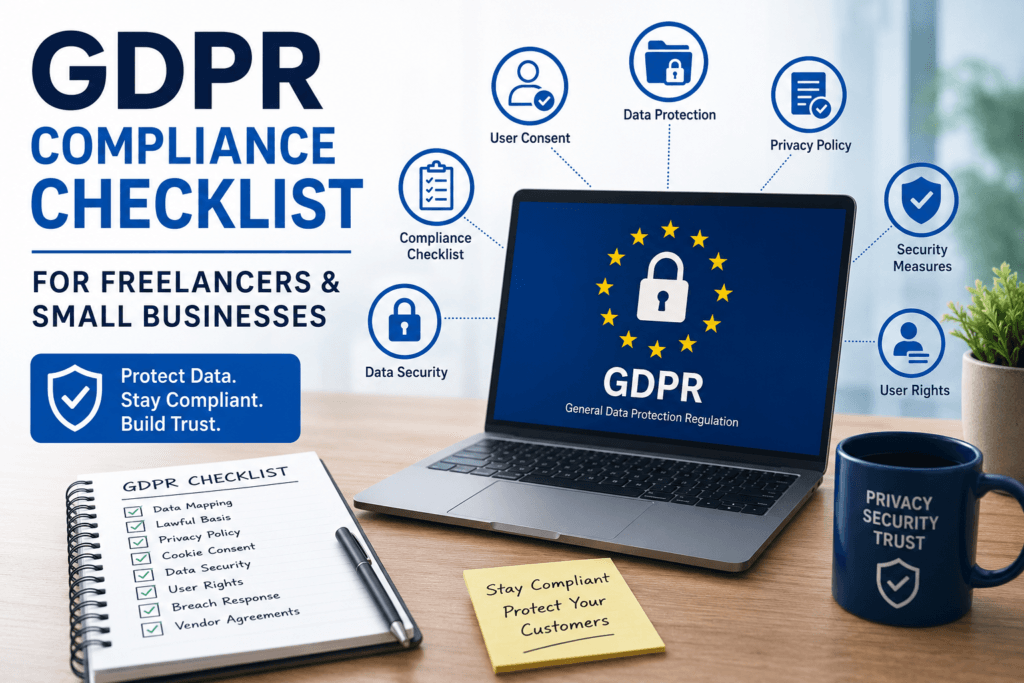
GDPR Compliance Checklist (2026)
Use the following checklist to improve your data protection practices.
1. Identify What Personal Data You Collect
Start by listing every type of personal information your business collects.
Examples include:
- Contact forms
- Newsletter sign-ups
- Customer accounts
- Purchase information
- Payment records
- Website analytics
- Support tickets
Knowing exactly what data you collect is the foundation of GDPR compliance.
2. Establish a Lawful Basis for Data Processing
GDPR requires businesses to have a valid legal reason before processing personal data.
Common lawful bases include:
- User consent
- Contract fulfillment
- Legal obligations
- Legitimate business interests
Never collect customer information “just in case” you might need it later.
3. Update Your Privacy Policy
Your privacy policy should clearly explain:
- What information you collect
- Why you collect it
- How long you keep it
- Who you share it with
- How users can request deletion or correction
Keep the language simple so visitors understand how their information is handled.
4. Obtain Clear Cookie Consent
If your website uses cookies for analytics, advertising, or tracking, users should have the ability to accept or reject non-essential cookies before they are activated.
A cookie banner should:
- Explain why cookies are used
- Allow visitors to manage preferences
- Store consent records
This is especially important for websites serving EU visitors.
5. Protect Customer Data
Strong cybersecurity helps reduce the risk of data breaches.
Best practices include:
- Enable two-factor authentication
- Use strong passwords
- Encrypt sensitive files
- Keep WordPress plugins updated
- Install a web application firewall
- Back up your website regularly
Protecting customer information is both a cybersecurity and GDPR responsibility.
6. Respect User Rights
Under GDPR, individuals have several privacy rights, including the ability to:
- Access their personal data
- Correct inaccurate information
- Request deletion
- Restrict processing
- Receive a copy of their data
- Withdraw consent
Create a simple process for responding to these requests within the required timeframe.
7. Review Third-Party Services
Many freelancers rely on third-party tools such as:
- Email marketing platforms
- Payment processors
- CRM software
- Cloud storage
- Analytics services
Verify that these providers also follow GDPR requirements and offer appropriate data processing agreements.
8. Create a Data Breach Response Plan
No business is completely immune to cyberattacks.
Your response plan should include:
- Identifying the affected systems
- Containing the breach
- Investigating what happened
- Informing affected users when required
- Recording the incident
- Improving security to prevent future attacks
Preparing in advance helps reduce confusion during an emergency.
Best GDPR Compliance Software for Small Business
Choosing the right GDPR compliance software for small business can save time and reduce the risk of compliance mistakes. These tools help manage cookie consent, privacy requests, and data protection documentation.
Popular options include:
- Cookiebot – Helps manage cookie consent banners and user preferences.
- Termly – Generates privacy policies and consent banners.
- OneTrust – Enterprise-grade privacy management for growing businesses.
- Usercentrics – Simplifies consent management for websites and apps.
Before selecting software, make sure it integrates with your website, email marketing platform, and analytics tools.
Common GDPR Compliance Mistakes
Freelancers and small businesses often make these mistakes without realizing they could violate GDPR:
- Collecting more customer data than necessary.
- Using pre-checked consent boxes.
- Publishing an outdated privacy policy.
- Ignoring customer requests to access or delete personal data.
- Not securing customer information with strong passwords and two-factor authentication.
- Forgetting to review third-party services that process customer data.
Avoiding these issues can improve both compliance and customer trust.
Benefits of Following a GDPR Compliance Checklist
Completing a GDPR compliance checklist offers benefits beyond avoiding regulatory penalties.
It can help you:
- Build trust with clients.
- Improve website transparency.
- Reduce the risk of data breaches.
- Organize how personal data is collected and stored.
- Strengthen your overall cybersecurity practices.
- Demonstrate professionalism when working with international clients.
For freelancers and small businesses, strong privacy practices can also become a competitive advantage.
Related Article :CCPA Compliance Guide for Freelancers: What California Privacy Law Means for Your Business
Frequently Asked Questions
1.Does GDPR apply to U.S. freelancers?
Yes. If you collect or process personal data from people in the European Union, GDPR may apply even if your business is based in the United States.
2.What is the first step in a GDPR compliance checklist?
The first step is identifying what personal data your business collects, where it is stored, and why you collect it.
3.Do small businesses need GDPR compliance software?
Not always. Very small businesses may manage compliance manually, but GDPR compliance software for small business can simplify cookie consent, privacy requests, and documentation as your business grows.
4.What documents are required for GDPR compliance?
Common documents include a privacy policy, cookie policy, records of processing activities, consent records, and data processing agreements with third-party providers where applicable.
5.What happens if a business doesn’t comply with GDPR?
Non-compliance can lead to investigations, enforcement actions, and financial penalties depending on the circumstances. Following a structured GDPR compliance checklist helps reduce these risks.
Conclusion
If your freelance business or small business serves customers in the European Union, following a GDPR compliance checklist is an important part of protecting personal data and maintaining customer trust. Start by understanding what information you collect, update your privacy policy, secure customer data, and create a process for handling privacy requests.
As your business grows, using GDPR compliance software for small business can make managing consent, documentation, and compliance much easier. Privacy regulations continue to evolve, so reviewing your compliance practices regularly will help keep your business prepared for 2026 and beyond.
For official guidance on GDPR requirements, visit the European Union’s official GDPR information portal: https://gdpr.eu/
Looking for a complete security roadmap? Our Cybersecurity for Freelancers and Small Businesses guide explains the essential cybersecurity practices every freelancer and small business owner should follow, including GDPR compliance, secure communication, password management, and data protection.